Art unsettles familiar ways of seeing. As Ernst H. Gombrich suggests, its capacity to surprise offers a form of mental rehearsal, helping us adapt to new demands and become more receptive to the unexpected.*
“Art unsettles familiar ways of seeing.”
Networked images now serve as an extension of memory, allowing people to preserve fleeting experiences and document forms of expression and resistance that official archives overlook. Yet the technologies that once promised to broaden visibility now confront us with a different kind of abundance.
Synthetic images are generated at a scale no individual could match. The everyday act of looking therefore demands greater discernment: assessing the credibility of sources and distinguishing between photographs, composites and synthetic productions. The human labour, authorship and source material behind these images are often obscured.
Artists face the growing power of platforms that treat creative expression as material to be filtered, extracted, replicated and resold. Within this struggle over our shared digital commons, questions of ownership, recognition and control become increasingly urgent.
The Language of Margins project invites writers from East Africa to introduce artists who use these platforms to bear witness and contribute testimony. Through these encounters, the project explores how images preserve experience, convey meaning and challenge what we accept as credible—pushing us towards the boundaries of our perception.
Opening paragraph paraphrases Ernst H. Gombrich, Reflections on the History of Art, edited by Robert Woodfield (Berkeley: University of California Press, 1987), p. 211 “Pushing us towards the boundaries of our perception and preparing us for the unexpected”.
Tanzania❈Karen Chalamilla
Virtual world, real bodies, radical feminism
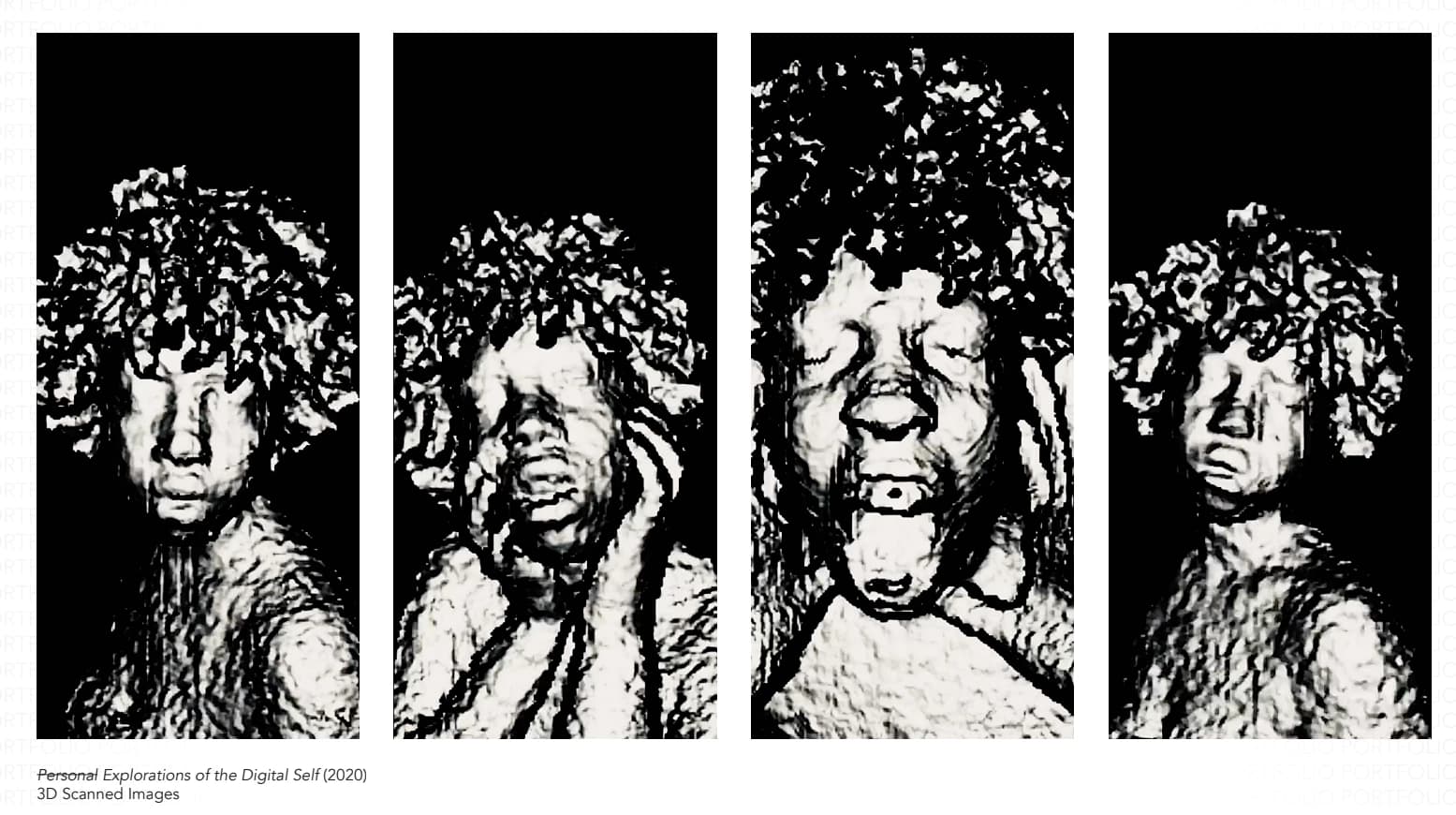
Explorations of The Digital Self — Arafa Hamadi
Minna Salami’s 2025 book, described by Brittle Paper as a philosophical reflection, asks “Can Feminism Be African?” While her conceptual framework is heavily influenced by West African epistemologies, cosmologies, and folklore, reading it led me to project her question onto East Africa: “Can Feminism be East African?”
I carried this question with me while perusing a very different text: the East African Community Gender Policy. Launched in 2018, the policy “provides a framework, intended to accelerate the realisation of gender equality, fairness between men and women, non-discrimination and fundamental rights in East Africa”. It is part of the commission’s Vision 2050, which frame gender equality and youth empowerment as cross-cutting issues in transforming East Africa into an “upper-middle income region”.
Though a positive step, the policy paper is anchored in legality and economic development rather than dignity and freedom. For East African nation states, improving women’s lives remains largely an instrument for economic growth rather than an end in itself.
In Tanzania, this view has deep historical roots: colonial-era policies treated the body as a unit of economic output, while post-independence Tanzania positioned it as a tool to build community and sustain households. Women thus bore an exhausting double burden as both economic producers and reproductive caretakers. This perception endures, trapping women’s bodies in a rigid binary and confining women’s social value primarily to the domestic sphere.
Unsurprisingly then, the policy makes no room for the ideological shifts needed to sustain its practical goals. It omits any mention of feminism or womanism, and mentions patriarchy as a system of domination only once, in the concluding glossary.
Yet the journey to freedom for East African women relies as much on reimagining received wisdom about womanhood as it does on legal framework reform..
“reimagining received wisdom about womanhood”
As Ugandan feminist and scholar Dr. Sylvia Tamale reminds us in Decolonization and Afrofeminism, her 2020 book, to control one’s own body includes the ability for one’s mind to imagine a better world.
In Tanzania, digital artists are steadily filling this imaginative lacuna. In the work of Turakella Gyindo, Valerie Asiimwe Amani, Arafa Hamadi, and Mihayo Kallaye, digital spaces serve as sites for expansive discourse and world-building. Through digital mediums, these artists assert that the female body is more than a site of subjugation, breaking beyond physical constraints to propose alternative imaginaries for autonomy and liberation.
Multi-media artist Turakella Gyindo’s staple material is the loofah, a familiar body-care tool. In Not (Spi)ritual , her exhibition at the 2026 Westwerk Hamburg art space , she loops recordings of physical performance pieces against tactile, earth-toned installations of Morogoro-cultivated loofah.
Bound up with domestic cleansing and bodily hygiene, the loofah sponge is deeply gendered. Gyindo video loops strip away the privacy of cleansing, transforming a gendered chore into a public and political declaration of autonomous existence.
For a 2025 essay on the evolution of Tanzanian sex education, I spoke to three educators about teachings on cleanliness, a rite of passage into womanhood for Tanzanian girls. It became clear that the rituals and performance of cleanliness not only facilitate health but signal successful assimilation into gendered roles. Educators took pride in imparting painstaking beauty and cleanliness routines—private rituals designed to project perfection in public. Performing them diligently and discreetly defines a ‘good woman’. By broadcasting this typically routine as public performance, Gyindo disrupts its gendered ascriptions.
This digital intervention exists on a continuum. While Gyindo’s Not (Spi)ritual uses digital formats to generate critical tension, Arafa Hamadi’s Explorations of The Digital Self, uses the medium as a tool for speculative world building.
Made in 2022, Explorations of The Digital Self exists entirely virtually, unconstrained by physical galleries. Created during a residency with Digital Artist Residency, the project features 3D scans and video depicting the artist’s body in motion and flux across the month-long residency.
Where Gyindo acknowledges the gender binary to interrogate it, Hamadi builds a world that collapses it entirely. “Hello, I’m Arafa. I am a non-binary artist, living,” text on screen reads, rejecting predetermined ways of being from the outset. The artist declares that their body and being as sites to be explored, while also constructing a utopia that has no space for performance, even as a site of departure for critique.
The word “living” invites audiences to see flux, rather than rigid norms, as the natural order. In motion, the 3D scans display a metallic sheen, reflecting light to highlight fluidity. Hamadi traces hands across face, craning neck and flexing limbs as if to study their range of motion. The renderings possess a haptic quality, appearing as if sculpted from sand—sturdy enough to hold shape, yet quick to disintegrate. By omitting fine detail, they deliberately discourage speculation about the body’s social functions.
Hamadi reframes bodily autonomy as the ability to do away with gendered existence. What could we learn from and about ourselves if we did not have predetermined societal norms? The artist says that even for them, this work has continued to function as a self-reflexive loop: they return to these digital renderings when crafting new work, using their recorded body for ongoing reflection and existence beyond gender binaries.
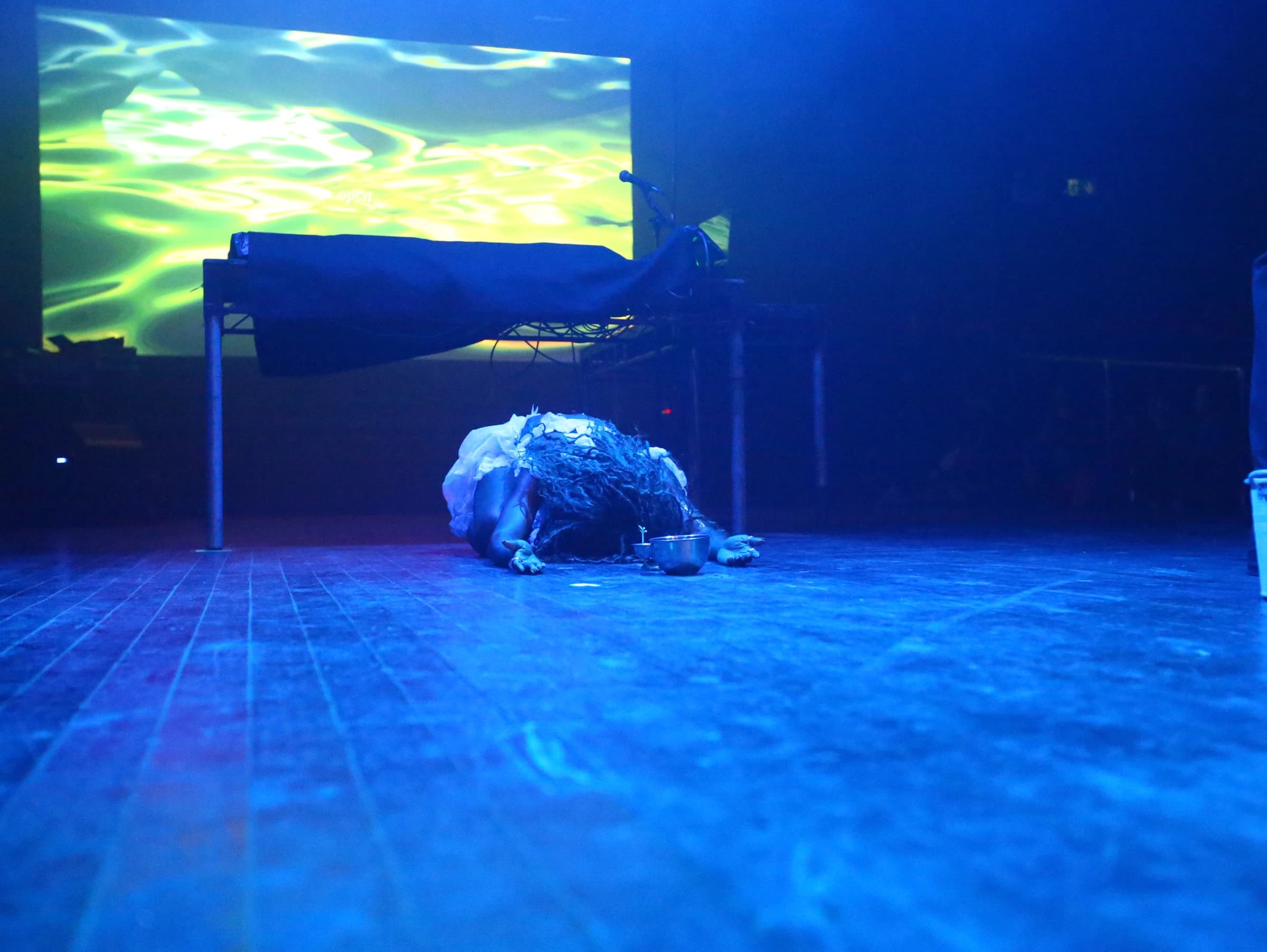
Body and being can be considered even beyond the limit of humanness, Valerie Asiimwe Amani’s project Bahari Chumvi (The Salted Sea) tells us. Using movement, sound, video, and scent, the multi-media work presents the Indian Ocean as a body holding histories of migration, loss, and return.
In the video performance, Asiimwe Amani uses her body for historical reclamation, framing femininity as a vessel for memory. Her dress disintegrates over time and her body mutates, evoking reconstruction and rebirth. Coarse salt against her skin evokes the harsh histories carried by both ocean and body. Like Gyindo, Asiimwe Amani politicises domestic life by performing private cleansing rituals publicly on stage.
Watching the performance, one’s mind is drawn to the parallels between the ocean and the female body: their fluid movement against static forces (ocean against rock; female body against patriarchal and colonial violence) and their shared experience of exploitation as sites of labour and extraction.
Yet beyond trauma lies their capacity for transformation. Asiimwe draws on Tanzanian indigenous cosmologies that trace ancestral memory through the maternal line to cast the female body as a conduit for myth-making and imagining futures free from patriarchal violence.
When she staged Bahari Chumvi, Asiimwe Amani used digital elements as central structural components rather than mere background visuals. As she noted in an interview with Forster Gallery, Zanzibar, the digital elements of the production helped collapse time, allowing audiences to experience historical memory, contemporary struggle, and live performance simultaneously. Where physical gallery spaces can feel static, the digital elements activated multi-dimensional layers that connected past to present.
Bahari Chumvi (The Salted Sea) — Valerie Asiimwe Amani
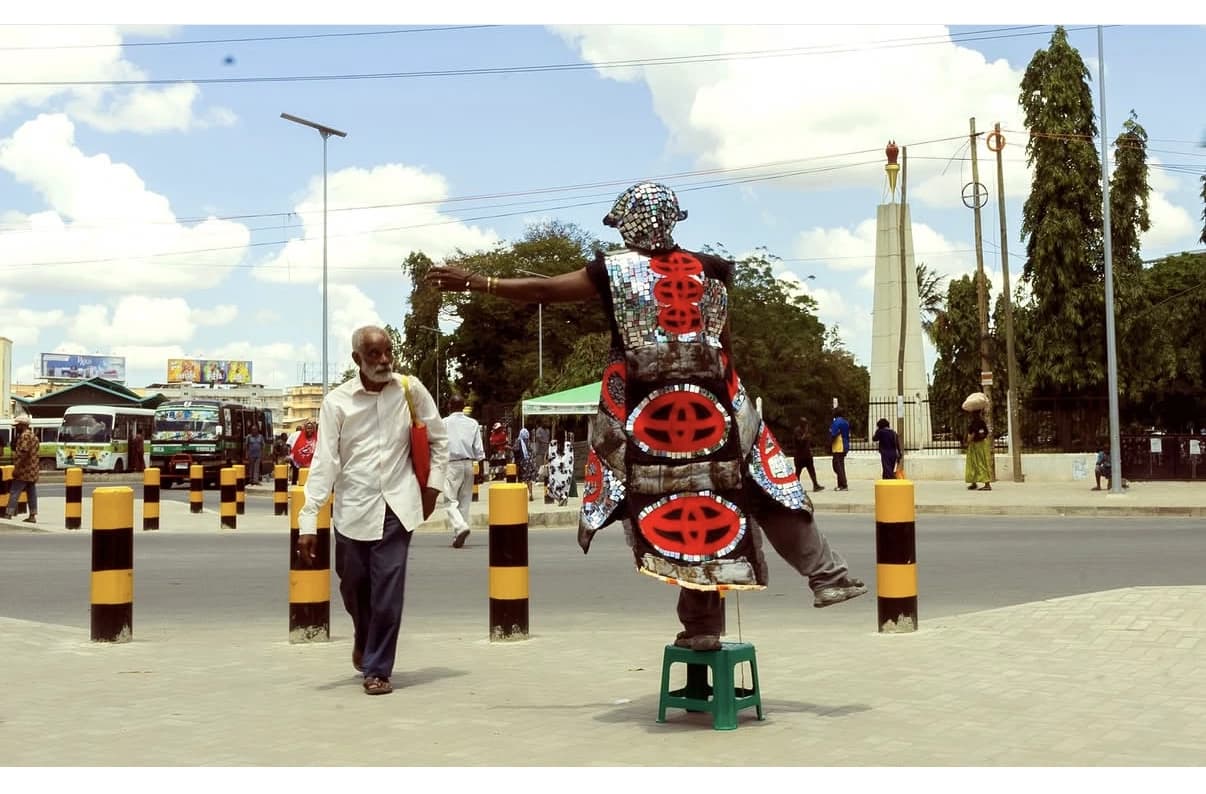
While Asiimwe Amani used digital tools to expand gallery space, Mihayo Kallaye’s 2025 project Shangazi Kaja (The Aunt Has Arrived) abandons gallery walls altogether. The performance—an improvised walk from Mnazi Mmoja through Uhuru Street to Kariakoo Market—is digitally shared and archived.
Grounded in the present, it directs our attention towards socio-economic and environmental exploitation. It poses a great comparison to Asiimwe’s work not only because of the contrasting departures (one from the past, and the other from the present), but also because Kallaye’s work further expands the idea of a public performance. The work is grounded in the philosophy of Ujamaa (collectivity), rejecting the ideal of the isolated artist in favour of shared, communal experience.
The title shifts political power to a female elder, utilizing myth-making much like Asiimwe Amani. In many Tanzanian communities, the “Shangazi” (paternal aunt) holds familial authority capable of disrupting patriarchal hierarchies. “Shangazi Kaja” also carries a playful resonance, referencing the checkered raffia bags brought by rural relatives visiting the city. By invoking this image, Kallaye captures the class dynamics and perceived intrusion of rural travellers into urban spaces.
Moving through the city in a cape and headgear inspired by initiation rites, Kallaye brings ancestral presence into the modern street. Rather than a body defined by economic output, the ‘aunt’ is an untamed spirit moving across dimensions; an agent of decoloniality.
Kallaye’s body is not biologically female. When he steps into the role to embody the spirit of Shangazi without presenting a literal female form, the performance disrupts binary ideas of the body.
Though Shangazi Kaja occurred offline, its preservation depends on digital technology. The uploaded video transforms a transient public performance into a permanently archived example of disruptive and collective art-making, expanding what the public has access to, in imagining the female body beyond rigid functional roles.
Shangazi Kaja (The Aunt Has Arrived) — Mihayo Kallaye
Digital technologies have expanded the geography and efficacy of artistic resistance. For Hamadi, digital tools create a borderless landscape for an e-feminist sanctuary. For Gyindo and Asiimwe Amani, hybrid materiality expands physical gallery dimensions. For Kallaye, digital space archives a transient offline performance.
“Digital technologies have expanded the geography and efficacy of artistic resistance.”
By expanding artistic geography, digital mediums amplify indigenous feminisms—a crucial disruption in Tanzania, where conventional public discourse remains dominated by rigid views of women as economic and reproductive units. It offers a vital intervention across the wider region, where policy frameworks like the East African Community Gender Policy too often reduce women’s liberation to a vehicle for economic growth.
About the author
Karen Chalamilla
Karen Chalamilla is a writer-researcher investigating the intersections of African art, pop culture, and political identities. Writing from a feminist perspective, she centers narratives often overlooked by mainstream media, with a particular focus on Black and African cultures. A National Book Critics Circle Emerging Critics Fellow and LOATAD Black Atlantic Residency alumni, her work has been featured in Africa Is A Country, The Republic, African Arguments, and The Citizen Newspaper.
Uganda❈Gloria Kiconco
Pixels of Protest
The digital frontier for art in Uganda’s restrictive climate
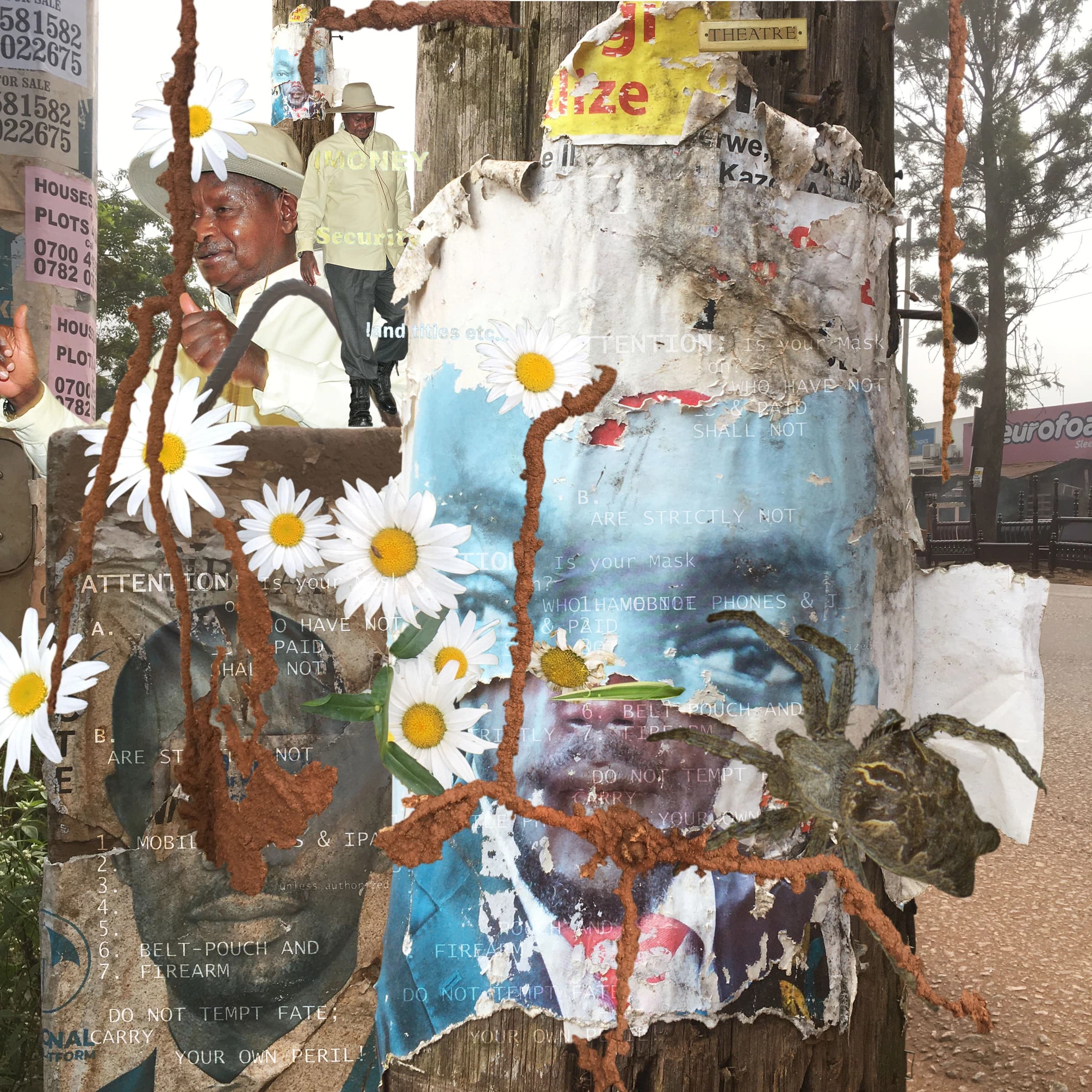
Political Commentary — R. Canon Griffin
R. Canon Griffin’s Political Commentary series is an unsettling reflection on Uganda’scurrent socio-political climate. Layering images and symbols of daily Ugandan life,the digital collages are a multi-entendre depiction of natural decay, passive life andhuman-made construction and destruction.
The first image in the series stands out because it incorporates photos of prominentUgandan politicians. But as you revisit the piece, termite trails, torn politicalcandidate posters and plastered ads for real estate brokers take prominence. Thenthe thin, transparent text floats forward, reading, “do not tempt fate”.
The fear that socio-political commentary invites misfortune haunts many Ugandanartists. Some digital artists are responding to this anxiety through varied practices:visual languages shaped by technique, necessity, and constraint. Art becomes a tooland tactic for navigating a restrictive context.
Subtlety doesn’t negate impact
Olivia Mary Nantongo’s preferred language is metaphor. Leaning into the philosophythat art cannot and should not tell you what to think, she favours circumspectionover plain speech. Artists can “communicate through metaphor, leaving room forinterpretation while still conveying powerful ideas,” she says. “Rather thanconfronting political issues head-on, I often approach them through symbolism,metaphor and personal narrative.”
“Rather than confronting political issues head-on, I often approach them through symbolism, metaphor and personal narrative.”
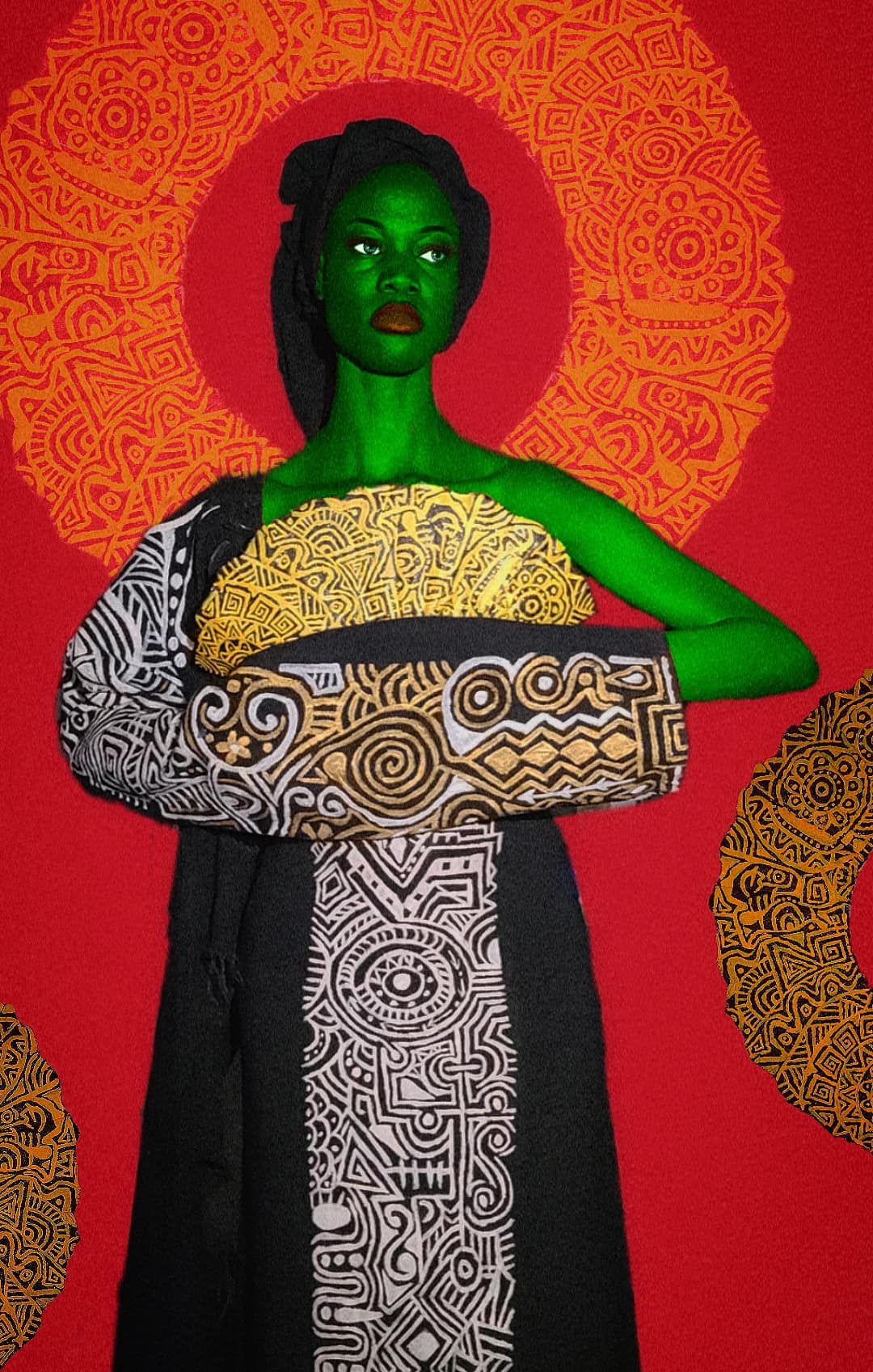
Nantongo turned to digital art during the constraints of the COVID-19 pandemic. Withthe country locked down and art supplies scarce, she pivoted to digital photocollages. Working as model, subject, and artist, she layers photos of herself with“bold colours, African-inspired patterns, painted textures, and symbolic elements” tocreate a distinctive visual language. Her work has circulated widely on digitalplatforms, particularly social media.
Nantongo’s collages are bold and provocative but she avoids controversy for its ownsake, despite its potential for visibility and profit in the digital ecosystem. Herintention is to provoke deep and sustained conversation around identity, memory,femininity and cultural heritage. She sees these themes as “universal enough toresonate widely yet rooted enough in the Ugandan experience to encourageaudiences to reconsider familiar ideas about gender, tradition and selfhood.”
Digital collage — Olivia Mary Nantongo
Finding leeway through digital tools
Art’s power flows primarily from the artist’s choice to confront or provoke, rather thanthe medium used. Artists like Nantongo retain impact even when adaptingtechnology solely for technique and distribution, rather than expression. Digitalintervention can offer artists “more leeway of expression,” says Natasha Karungi, adigital artist known as Kashushu. Ugandan artists who need to address contentioustopics often turn to digital tools for this freedom.
Dianah Bwengye is one such artist. She often feels that circumspection isinsufficient; that it’s the artist's job “to highlight the wrongs of our society”. Citing thecriminalisation of LGBTQ+ Ugandans, Bwengye says “it needs to be talked aboutshamelessly” despite the risk of imprisonment under an infamously harsh lawpassed in 2023. Fittingly, her artistic language is Augmented Reality(AR).
InLooking Within, a five-painting collection that was inspired by her 13-year-old niece,Bwengye traces her own journey into womanhood – a journey in which she facedinequalities, pressures, and disillusionment but ultimately landed in herself. Hercollection, which featured in the 2025 Annual Njabala Exhibition, is animated withAR, immersing the audience in a journey that most Ugandan women travel.
The technological intervention helps the collection to escape the boundaries oftraditional painting. Viewed through an app, Bwengye’s paintings come to life, givinga story about resisting patriarchal impositions on womanhood a fitting sense ofagency. The experience suggests to the audience that they too can escape bothliteral and figurative limitations, transforming the collection from a story into a guideto liberation.
So what if such forceful art is not censorship proof? Bwengye argues that it’s stillworth making in restrictive contexts; digital art remains available to global audienceseven when banned in its country of origin.
Kashushu, who has emerged as one of the most prominent artists in Uganda’snascent digital art scene, also employs a lens that is prone to backlash: feministcritique. Her indelible collection Neitwe Ba Nyabingi, which featured in the 2025Annual Njabala Exhibition (ANE), draws from the spiritual world of the pre-colonialkingdom of Mpororo, later adopted by tribes in western Uganda, including theBanyankore, her own heritage. Inspired by a statue of Nyabingi at the Igongo CulturalCentre in Mbarara, the series uses portraits depicting feminine power to connectQueen Kitami, the original Nyabingi, to the Nyabingi within every woman in thecontemporary world.
Within the art world, Kashushu’s feminist reading of the Nyabingi mythology may beuncontroversial. But in Uganda’s wider patriarchal, Christian context, Neitwe BaNyabingi is provocative and terrifying for calling back to the traditional religions thatcolonial Christianity dismissed as devilish.
“When you examine the history of religion and how it was used to colonise Africansand diminish women through patriarchy, everything about your spiritual connectionto a higher power becomes political,” Kashushu says. Her feminist reclaiming of theNyabingi myth subverts the Christian lens, protesting Christianity, patriarchy, and thepolitical structures they created. Kashushu is, however, careful to clarify she is notagainst religion or the grounding and hope it provides. She does, however, questionreligious institutions’ tendency to belittle women and punish those who do notsubmit.
“everything about your spiritual connection to a higher power becomes political”
A complicated frontier
Supported by art institutions like Afropocene, Njabala Foundation, Xenson Art Space,and Droop Canvas, more artists are embracing digital art. This evolution empowersgrowth in the Kampala art scene, though unevenly, and raises new ethical dilemmas.
Digital infrastructure in Uganda both empowers and restricts this growth, dependingon the artist’s location. While those with reliable internet access see their work travelfurther, electricity outages, sporadic internet, and limited device access createobstacles for others.
Moreover, many artists are concerned about unchecked, rapid technologicaladvances. Kashushu, for instance, maintains a love-hate relationship with the latestdigital frontier: artificial intelligence. She is concerned that mainstream AI modelstrain on artists’ work without recognition or compensation. To anyone embracing AI,she asks, “How are we working around it?”—referring to the unethical use of artists’work and consumer data.
Sceptical artists like Kashushu might find food for thought in Evans Akanyijuka’spractice, which experiments with AI while grappling with the technology’s darkerside.
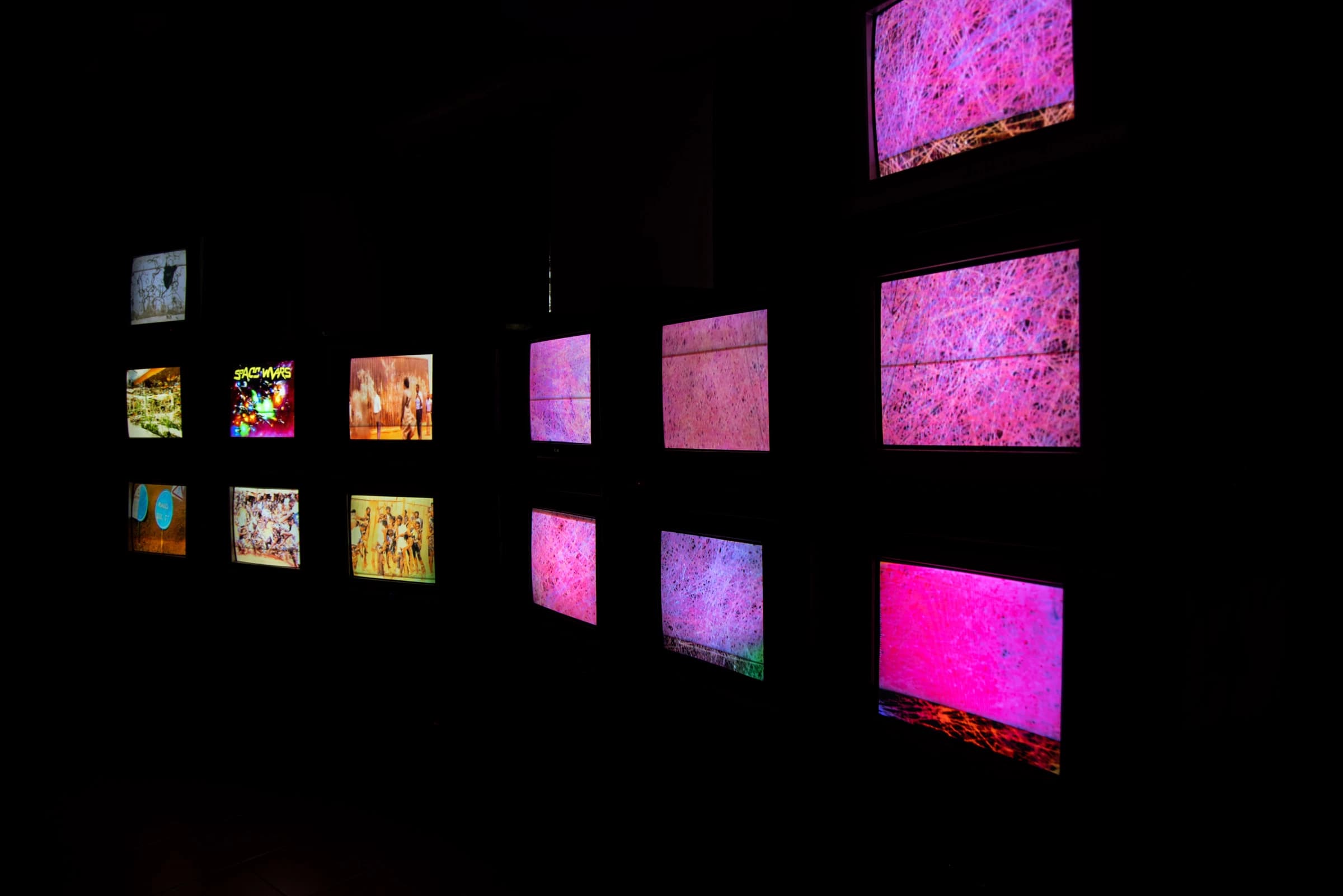
Akanyijuka’s 2026 solo exhibition, LORA as an Archive: The Living Archive atAfropocene, uses AI as an archival tool. By feeding curated photographs into apre-trained AI model, Akanyijuka created a living archive of constantly regeneratedimages of everyday scenes from Uganda and South Africa, including vivid, greenterraced hills. The AI-generated archive, projected across 14 CRT screens, wasdesigned “to reactivate memory and explore new possibilities within historicalmedia,” said Akanyijuka. It also inevitably prompts questions about the detrimentaleffect AI data centres will have on the natural environments depicted.
LORA as an Archive: The Living Archive — Evans Akanyijuka. Photo: Ethel photography
Akanyijuka partially mitigated this impact by using LoRA (Low-Rank Adaptation), anefficient technique for adapting large pre-trained models. It minimises computationaland memory usage, making his use of AI faster, cheaper, and more energy-efficient.Still, he acknowledged AI’s environmental impact within the installation: the CRTscreens were installed in a hot, dark room permeated by the overstimulating drone ofmachines. By bringing the physical consequences of AI into the room through noise,heat, and overwhelming data, Akanyijuka intertwined his exploration of AI’s potentialwith a critique of the technology’s energy consumption, destructive emissions, andnoise pollution. The juxtaposition acknowledges that while his use of LoRA may bemore efficient, it does not erase the technology’s environmental impact.
Regarding the other ethical question—training models on artists’ work—Akanyijukaapplied similar thoughtfulness. He approached 20 photographers for permission touse their work. This selective process also addressed another ethical issue: theabsence of diverse data in current AI models. Collaborating with African artistswould “bring to life DATA not otherwise accessed by typical models, or included inWestern-biased datasets.” Ultimately, only four consented, and the photos in hisinstallation are exclusively from them. This approach is radically different to BigTech’s way. US technology behemoths like Oracle stand accused of taking whateverthey could get their hands on. Adobe, a suite of programs used by most digitalartists, has been selling customer data to AI systems, says Kashushu.
About the author
Gloria Kiconco
Gloria Kiconco is a Ugandan poet, non-fiction writer, and zine-artist. She has published poetry with PREE Lit Magazine, Transition Magazine,The Weganda Review,20.35 Africa(2018)and Dear Nev: An Anthology of East African Writers. Her personal essays are published onAdda andMore of Us. Gloria’s arts journalism features in People Stories Project, Dazed magazine, The Wire, Perform! And ARTAFRICA.
Gloria was one of the inaugural Writers-in-Residence (2019) with the Goethe Institut Burkina Faso,the first poet-in-residence with the Manchester Poetry Library (2023) and a 2024 Prince Claus Seed Awardee. Herself-published poetry zines include SOLD OUT (2016), RETURN TO SENDER (2018), You Are Lost, You Are Here X(2020), Tunnel of Delight (2021), When These Three Meet (2026). In 2025, she attended the PREE Writer’s Studio in Kingston, Jamaica and the Obsidian Foundation Retreat.
Her exhibited works, in partnership with Borderlands Art, includeCardinal Directions (2024), Negative Spaceat the Atlanta Art Fair 2025 and her first solo exhibition, Poetics in Print (2026), at Latitude 0 in Kampala.She is the founder of the Kampala Art Book Zine Fair which held its first edition in July 2026.
Kenya❈Keith Ang’ana
On digital art in Kenya
Kasongo — Kibet Bull
Kenya experienced a political re-awakening in 2024 when young people nationwide protested the year’s proposed finance bill—the annual taxation legislation. Before protestors took to the streets, anger raged on social media, with digital artists playing a central role in mobilising and amplifying popular concerns.
With Kenya’s Eurobond maturing in 2024, the government sought to raise revenue to settle the debt. That year’s finance bill proposed a 15% tax on content creators’ social media earnings, an eco-levy on plastic packaging, and a vehicle congestion tax. This angered citizens already struggling with high living costs and stagnant wages.
Initial expert analysis of the bill was too technical for most Kenyans. Content creators changed this by translating clauses into local languages for TikTok. Supporting this organic civic education movement, technologists created a large language model to answer public questions about the bill.
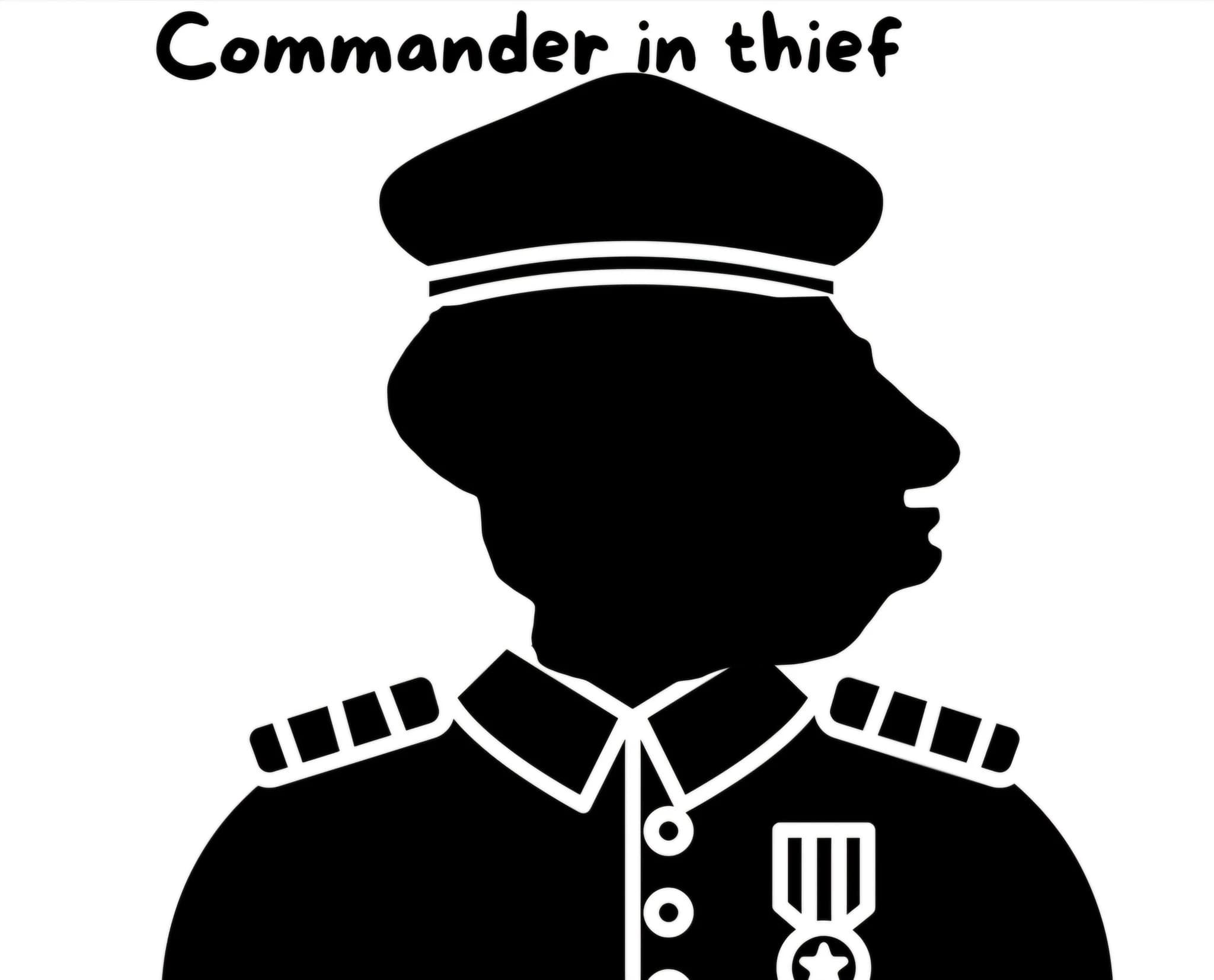
Kibet Bull became one of the most prominent visual artists to join this collective effort. His caricature style depicted the president as ‘Kasongo’, a silhouette with a big head. Though he had previously done little political commentary, the president’s dismissive reaction to the movement—specifically labelling protestors ‘treasonous criminals’—spurred him to action.
Bull’s main platform was X (formerly Twitter), where posts typically gained over 3,000 likes, catching the attention of politicians like Busia Senator Okiya Omtatah. Shared across Instagram, TikTok, and WhatsApp, his artwork also appeared on walls, T-shirts, and stickers.
Soon, Bull received threats to stop his art or face the ‘system’. On 24 December, while visiting Senator Omtatah, he was abducted. Kenya’s Directorate of Criminal Investigations reportedly held him until 6 January, when he was dumped 350 km from home.
The abduction backfired, creating the Streisand effect: as news of his disappearance spread, so did his artwork. The attempt to cow him failed. Upon his reappearance, Bull reminded the authorities that art is a societal mirror—something the government should use to gauge public sentiment, not fight.
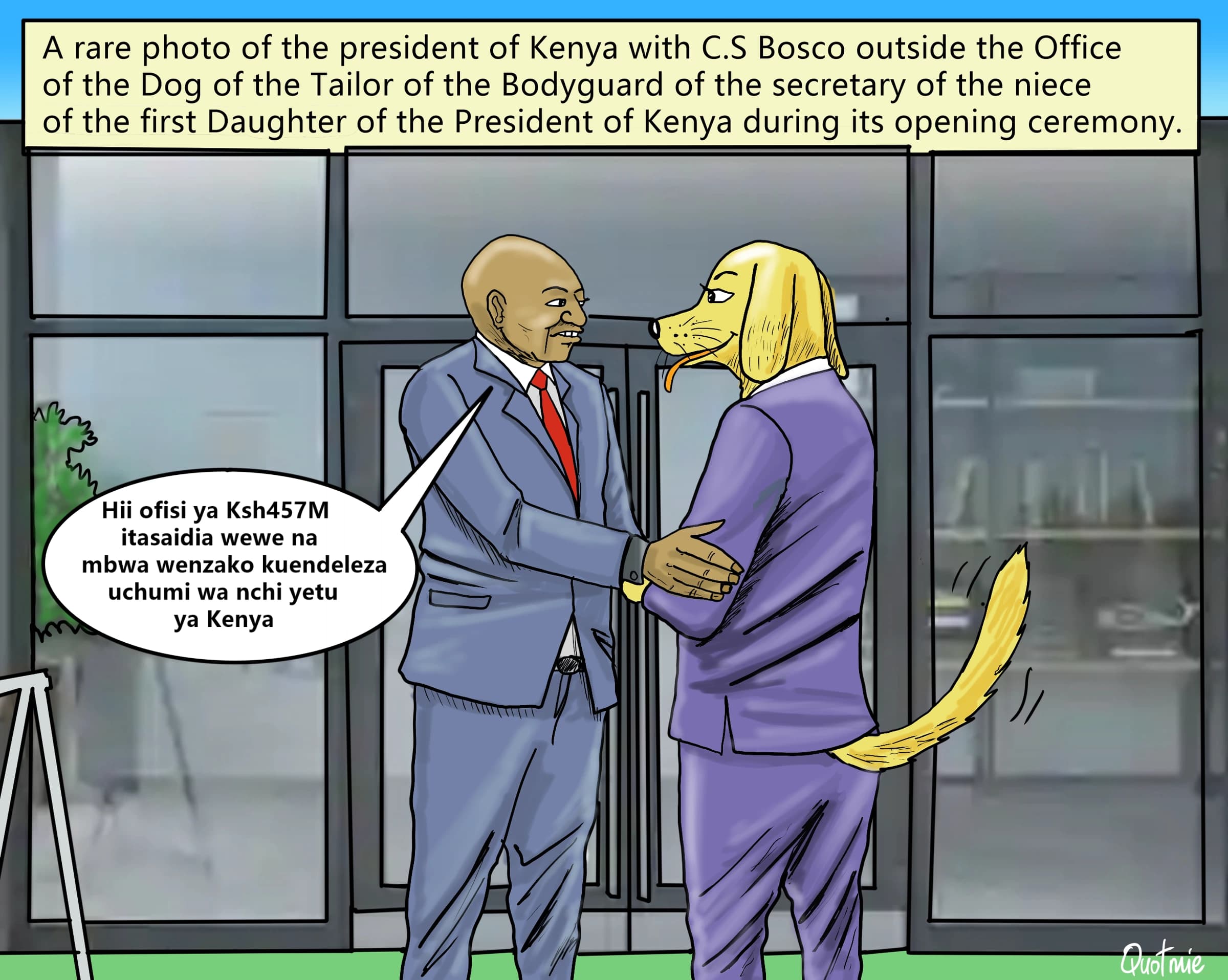
The protests also prompted Quotmie to pivot to political commentary. He had dabbled in it before: in 2018, he sent a piece to Gammz, a cartoonist at The Standard, who was impressed enough to publish it. Earlier, Quotmie was shortlisted in an editorial cartooning competition, where judges called his work self-explanatory and unconventional. These recognitions inspired him to design comics, an interest developed during his graphic design studies at Kenyatta University, where he graduated with a Fine Arts degree in 2017. His portfolio includes over 100 comics on various topics, including marine life and wildlife. He sells his comics online, in book, sticker and painting format but wishes he could afford access to the physical exhibitions like Nairobi Comic Convention (NaiCCon) which he describes as the best gathering for nerds like him who like to draw, write and read comics and manga.
The discourse around the 2024 Finance Bill triggered Quotmie emotionally. Driven by anger, he created political comic art that drew from daily news broadcasts. On Instagram, his work provided a learning service for people unable to follow news daily. His posts gained numerous likes, boosting his profile. To avoid arrest or retaliation, Quotmie refrained from physically exaggerating characters involved in the finance bill debate.
Quotmie still does not consider political art his main focus, but he remains open to creating it. He finds it challenging and creatively stimulating, as it requires rendering serious politics entertaining and clear using minimal text.
CS BOSCO — editorial cartoon
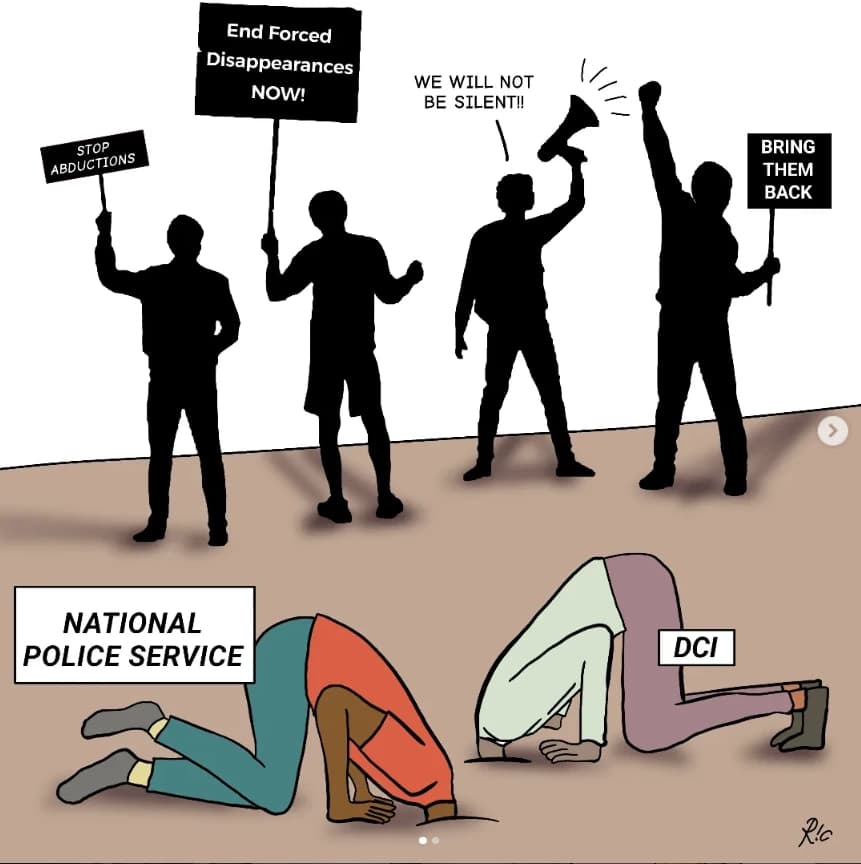
Unlike Bull and Quotmie, Ric Dicer had been making political art for a few years by the time the 2024 Finance Bill discourse emerged. In 2021, Siasa Place, a youth-oriented civic-tech organisation, admitted him for a one-year fellowship for creatives to learn how to advance civic knowledge. Dicer applied because he was already involved in public education, making infographics for public health messages. After his tertiary studies in Public Health, he found that he was more interested in pursuing the communications aspect of the field, rather than direct service delivery so he bought an iPad and started drawing.
At Siasa Place, Dicer trained alongside a spoken-word artist and a journalist. Under a mentor's guidance, he produced a weekly editorial cartoon for review. That rigorous training built a strong work ethic. Siasa Place also introduced him to civil society organisations that frequently commission his digital artwork. As his skills improved, he expanded into public graffiti and murals.
“The consistency that I built during the Siasa Place fellowship paid off during the 2024 Finance Bill protest period. I would conceptualise an idea within minutes of an occurrence, sketch in less than an hour, then color it in 2 hours. Thanks to this fast pace, I posted new artwork on Tiktok and Instagram every two days. I had a heavy preference for these two platforms because I wanted to reach the young Kenyans.”
“I wanted to reach the young Kenyans.”
This consistency built a loyal audience, raising Dicer's profile beyond his usual circle. However, this increased visibility also increased his fear of unwanted attention from the establishment.
Walking in town one day, Dicer was accosted, arrested, and handcuffed by plain-clothed men. Terrified, he feared his captors were part of the Directorate of Criminal Investigations or the National Intelligence Service—agencies frequently accused of abducting creators of anti-government material. It turned out they were City Council officers harassing him a small bribe. Following the scare, Dicer slightly adjusted his artistic tone to be less provocative without diluting his message. He continues to create artwork that promotes civic engagement, including pieces he designed for Allan Ademba’s voter mobilisation movement, ‘NIKO KADI’, and individual editorial cartoons.
Unlike Quotmie, Dicer does not seek physical exhibition space. He prefers digital publishing, which reaches global audiences without the spatial limitations of physical galleries.
Artwork: Ric Dicer
In the beginning, there was Edward Gitau and Hirst
Kenya’s 2024 Gen-Z awakening minted new political artists, but comic art in the country began more than six decades earlier. The history of Kenyan comic art dates back to Edward Gicheri Gitauto in the 1950s, a former electrician who created the comic strip ‘Juha Kalulu’.
‘Juha’ is the Swahili word for ‘clown’, and ‘Kalulu’ is Nyanja (a Malawian language) for ‘hare’. The comic followed a clownish man and his dog on various rural misadventures. Gitau aimed to extend traditional oral storytelling beyond the fireplace using visual cartoons.
First published in Tazama magazine, the strip moved to Baraza, and finally to Taifa Leo in 1960. It became the longest-running comic strip in East and Central Africa, appearing continuously until Gitau's death in 2016.
Five years after ‘Juha Kalulu’ debuted in Taifa Leo, Terry Hirst left Brighton, England, for Kenya. Responding to an advertisement for art teachers in Africa, he chose a two-year contract in Kenya over five years in Ghana. At Embakasi Airport in Nairobi, Hirst was received by Attorney General Charles Njonjo before taking up a post at Kenya High School.
As a child, Hirst read newspapers avidly, drawn to editorial cartoons. After high school, he chose a Fine Arts course at Brighton College of Art over study at the University of Oxford. A talented artist, he was appointed Head of Art at a large Nottingham school immediately after graduating.
At Kenya High School, Hirst designed a new art room alongside Peter Kareithi, the education ministry’s art inspector. Together, they developed a creative education model to train professional art teachers for Kenya's expanding secondary schools.
In 1966, Hirst joined the University of Nairobi and Kenyatta University College. Working with George Maloba—one of Kenya's few fully trained artists at the time—they established Fine Arts departments at both institutions and introduced a three-year Bachelor of Education in Arts degree, training Kenya's first generation of comic artists.
As a working artist, Hirst contributed cartoonist work to the Daily Nation newspaper on a freelance basis. In 1971, Hillary Ng’weno invited him to illustrate his popular weekly satirical column, ‘With a Light Touch’, which highlighted Kenya’s socio-political evolution. The two worked so well together that two years later, they created a satirical magazine based on one of the column’s characters, Joe. Through its central character, a survivor who has to laugh in order to prevent himself from crying, the Joe magazine provided critical commentary on the social, economic and political news of the day.
With Joe magazine and editorial cartoons on the Daily Nation (which came to be synonymous with the days of the week in which they were published – ‘Hirst on Friday’ and ‘Hirst on Sunday’), Hirst introduced the idea of caricature for political commentary. It was he who first illustrated Kenyan politicians as the gluttonous pot-bellied ‘Bwana Mkubwa’ who steals public money for their own benefit, leaving the common citizenry to suffer, says Dr. Joyce Nyairo. He was also the first cartoonist to draw former President Jomo Kenyatta, capturing the mood of the country after his death by depicting him as a spirit hovering over the clouds.
Political repression intensified after the 1982 attempted coup against President Daniel arap Moi, eventually forcing Hurst out of his cartoonist role at the Daily Nation. He was also compelled to close Joe and eventually dismissed from his lecturer position at Kenyatta University College.
By then, Hirst had laid the foundation for political caricature in Kenya, inspiring and mentoring a new generation of cartoonists including Paul Kelemba (Maddo), Sam Kahiga, and Frank Odoi.
The era of Gado & Maddo
The decade following the attempted coup was one of Kenya's darkest political periods. To consolidate power, President Moi established single-party rule via Section 2A of the constitution. Kenya became an autocracy where media was muzzled or co-opted, leaving anti-government resistance to underground publications like Pambana, Mwakenya, and Coastweek.
In 1981, Adrian Grimwood invited young illustrator Paul Kelemba to create a Modesty Blaise–style comic strip for Coastweek. Using the pen name Mapolomoko (Swahili for ‘landslide’), Kelemba worked there for five years before joining the Daily Nation in 1986, where writer Brian Tetley advised him to adopt a short, memorable pseudonym.
Drawing inspiration from New York's Mad Magazine, Kelemba adopted the pen name ‘Maddo’ and named his column ‘It’s a Madd Madd World’. Originally a three-panel black-and-white strip, editors Sean Egan and John Lawrence encouraged him to develop a composite graphic feature. Maddo expanded it to a half-page column, which evolved into a full-page, full-colour feature after he moved to The Standard in 1992.
By December 1991, activists pressed Moi into ending the one-party state and restoring multi-party democracy. As press freedom returned, the 1992 general elections offered an opportunity to vote Moi out of office.
In November 1992, Maddo made a landmark move in editorial cartooning when Society Magazine publisher Pius Nyamora commissioned him to design an election cover. His illustration depicted President Moi in a steeplechase race against rivals Kibaki, Jaramogi, and Matiba, who tripped over hurdles Moi had set. Believing absolute political control was ending,
At that point, the team anticipated Moi's defeat and therefore the end of his absolute political control. Still, making that caricature took temerity that Maddo is still proud of. “I’m happy to have been part of the wave that ushered in media freedoms enjoyed by young generations today,” he says. “Depicting the president in the 80s was taboo. Even if a cartoonist desired to do so, editors wouldn’t allow it, understandably. Special Branch operatives crawled everywhere and many of my colleagues were tortured and detained.” When Society Magazine commissioned me to caricature Daniel Arap Moi openly for the first time in 1992, he says he did it because “I was driven by the desire to see positive change in governance, respect for human rights and freedom of speech.”
“I was driven by the desire to see positive change in governance, respect for human rights and freedom of speech.”
Maddo got away with that gutsy caricature, confirming that Kenya’s free speech landscape had changed, a shift that cartoonists like Gado seized upon. “Kenyan presidents have been subject to cartoonists’ ridicule ever since,” says Maddo.
When Gado joined the Daily Nation in 1992 following Maddo’s departure, he placed an Art Buchwald quote above his desk: “Dictators from the political left or right fear the political cartoonist more than they do the atomic bomb. No totalitarian government can afford to be ridiculed.” Driven by this idea, he drew Moi asking for five more years with a walking stick, the first salvo in Gado's 23-year career of fearlessly caricaturing presidents in print.
During early-1990s constitutional reform debates, when Moi dismissed public understanding of the constitution by referring to a wildered ‘Wanjiku’ – the common, poorly-educated citizen. This character became a recurring feature in Gado’s cartoons in she is reclaimed as a symbol of popular social justice, contrasted against corrupt politicians who are often depicted as fat cats, pigs, vultures, crocodiles, and hyenas. “To draw people as animals is to degrade them because their behaviour is disgraceful. And Gado ensured that he gave them grotesque proportions to capture how alienating and out of the ordinary corruption is, how outlandishly the corrupt behave,” says Joyce Nyairo. Positioned at the edge of Gado’s drawings, Wanjiku breaks the fourth wall to comment on the political excess or ask readers thought-provoking questions.
Gado’s tenure at the Nation ended abruptly in 2015 over a cartoon in The EastAfrican depicting Tanzanian President Jakaya Kikwete half-naked in a massage parlour, fed grapes by concubines representing government failings.
Following the caricature, the Tanzanian government banned The EastAfrican and withheld state advertising for a year. Seeking to protect revenue, Nation Media Group's CEO asked Gado to take a year-long sabbatical, after which his contract was not renewed—demonstrating ongoing state pressure on press freedom.
Thanks to the existence of digital formats of distribution, it is now possible to bypass censorship by the state. Artists like Quotmie, Kibet Bull and Ric Dicer don’t have to worry about whether their work will be published, since the initial gatekeepers that existed have been removed. The artists can now use social media to share their work, ensuring deeper and farther penetration than initially existed. Digital publications like The Continent, where Gado does his caricatures, have gained a continental reach, meaning the work spreads even farther and wider (add that to the fact that they are independent, therefore the chances of being clamped down for reasons alike those The East African faced, are close to null. It is therefore worth commending the role that digital distribution of art plays.
About the author
Keith Ang’ana
Keith Ang'ana is a writer, researcher and historian, who focuses on unearthing stories from Kenya's past and bringing them to the light. In his capacity as a writer, he has written for publications such as The Elephant, Africa Is A Country, Brittle Paper, Business Daily, Daily Nation etc. He is also the Editor of the Kenya Past & Present (KP&P), an annual publication of the Kenya Museum Society, which supports and promotes the National Museums of Kenya. In his capacity as a researcher and historian, he has been part of the research team for the Too Early for Birds theatre production company, which does theatre plays on Kenyan history. He is also the Founder and Executive Director of Qwani, which is a collective that provides young artists with a platform to showcase their work.
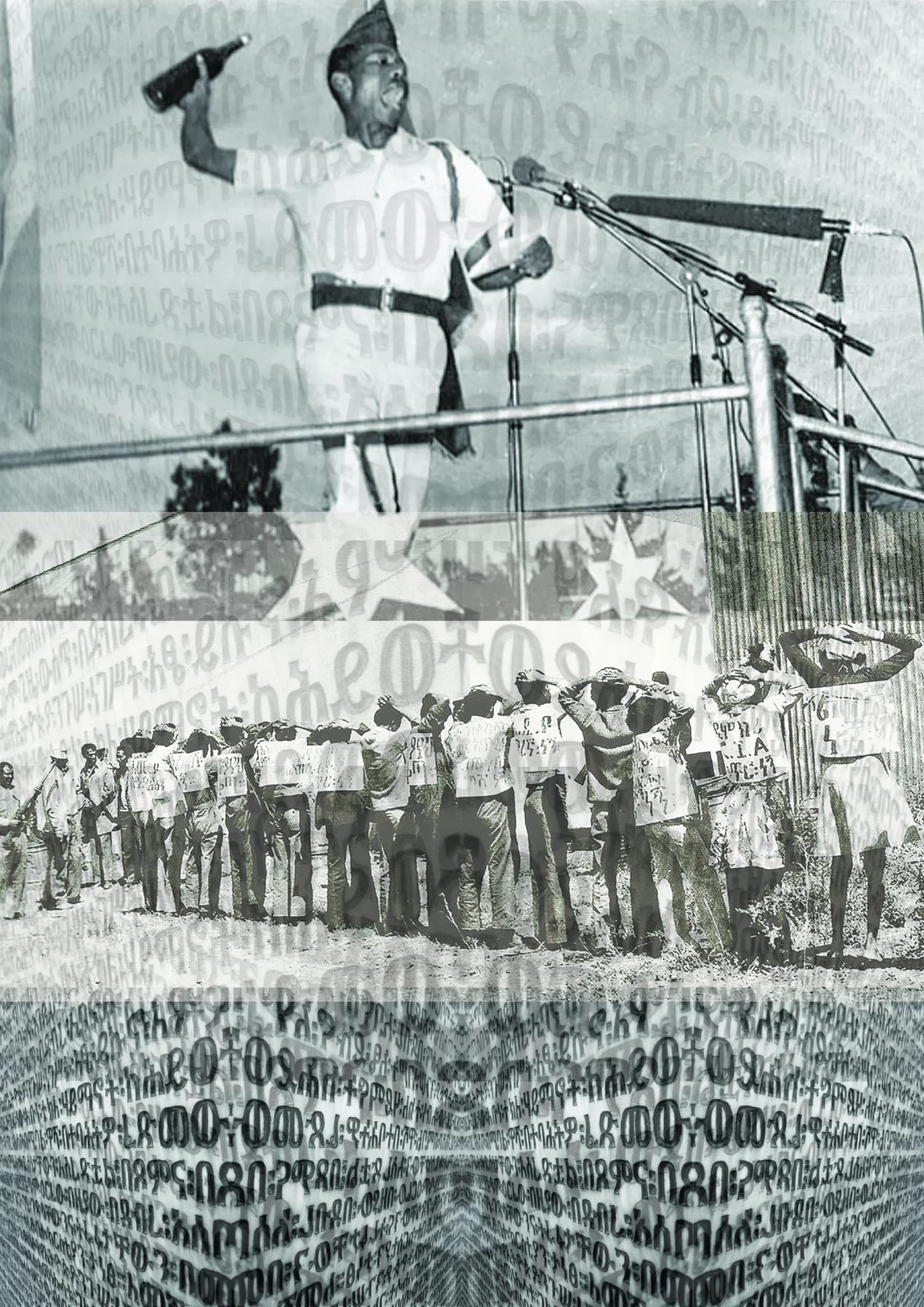
Black-and-white photomontage of a speaker, a crowd, and layered lettering.
A definable act, such as the prohibition of an artwork, the closure of an exhibition, or the blocking of a publication, is typically the first step in accounts of censorship. Instead, the lack of such an act is where this essay begins.
Working alongside artist Natnael Ashebir, I proposed to galleries and cultural institutions in Addis Ababa our collaborative exhibition on land, memory, ownership, and urban transition between 2023 and 2025. The answers we received varied.
Some responses were questions about the topic and intentions of the project, before all communication eventually stopped. In one instance, a space agreed to the proposal and even went as far to schedule potential dates, and a few others did not bother to respond.
After months of applying, none of the organizations we contacted in Addis Ababa were willing to host the exhibition, and yet none outrightly rejected our proposal or asked it be banned. As disheartened as myself and Natnael were, we looked for opportunities to share our work that bore fruit, Land, Politics, and Ownership was developed in Ethiopia and first exhibited at the African Arts Trust in Nairobi between November 28, 2025, to February 28, 2026.
"The work is rooted in the urban landscape of Addis Ababa, where the scars of demolition and change are felt on the body as much as they are seen by the eye. The ruins of destroyed houses are more than physical absences with erasures of memory, lineage, and belonging, the intimate geography of a home replaced by the anonymous geometry of a construction site. This collaborative investigation explores the deep conflict that arises when the internal, emotional world of nostalgia and the protective rituals of traditional practice collide with the external, coercive forces of modern urban politics. It is a study of the violence inflicted when personal history is overwritten by political agendas" TAAT
This idea for this exhibition began as a curatorial note in 2022, Natnael A. joined me as a collaborator in 2023, as we worked to examine the role of land in Ethiopia's contemporary politics. As a curator and researcher I drew from the few historical records remaining, and relied on my imagination as an artist, for the unrecorded and missing events that followed those fixed archives.
The 1995 Ethiopian Constitution established the framework for ownership and described land as the common property of Ethiopia as a nation and its citizens. Our exhibition examined the claim to collective ownership, as well as the present day demolition of Addis Ababa as a shift in the material conditions of remembering. The question was not just who owned the property, but also what should be remembered as buildings are demolished and their records remain incomplete.
As we developed our work and research, we hoped to have access to some visual representations of the memory of the land and spaces that had changed or disappeared, but we only had access to incomplete archival images, and it was not possible for us to document the demolitions and transition as it happened.
With the traditional documentary sequence of identifying and researching a location, no longer an option, we had to rely on archival sources, however the authorship of these photographs was omitted. Who had taken these photos and from whose perspective? These omissions deliberate or not exposed how the images are enmeshed in classification and institutional power systems.
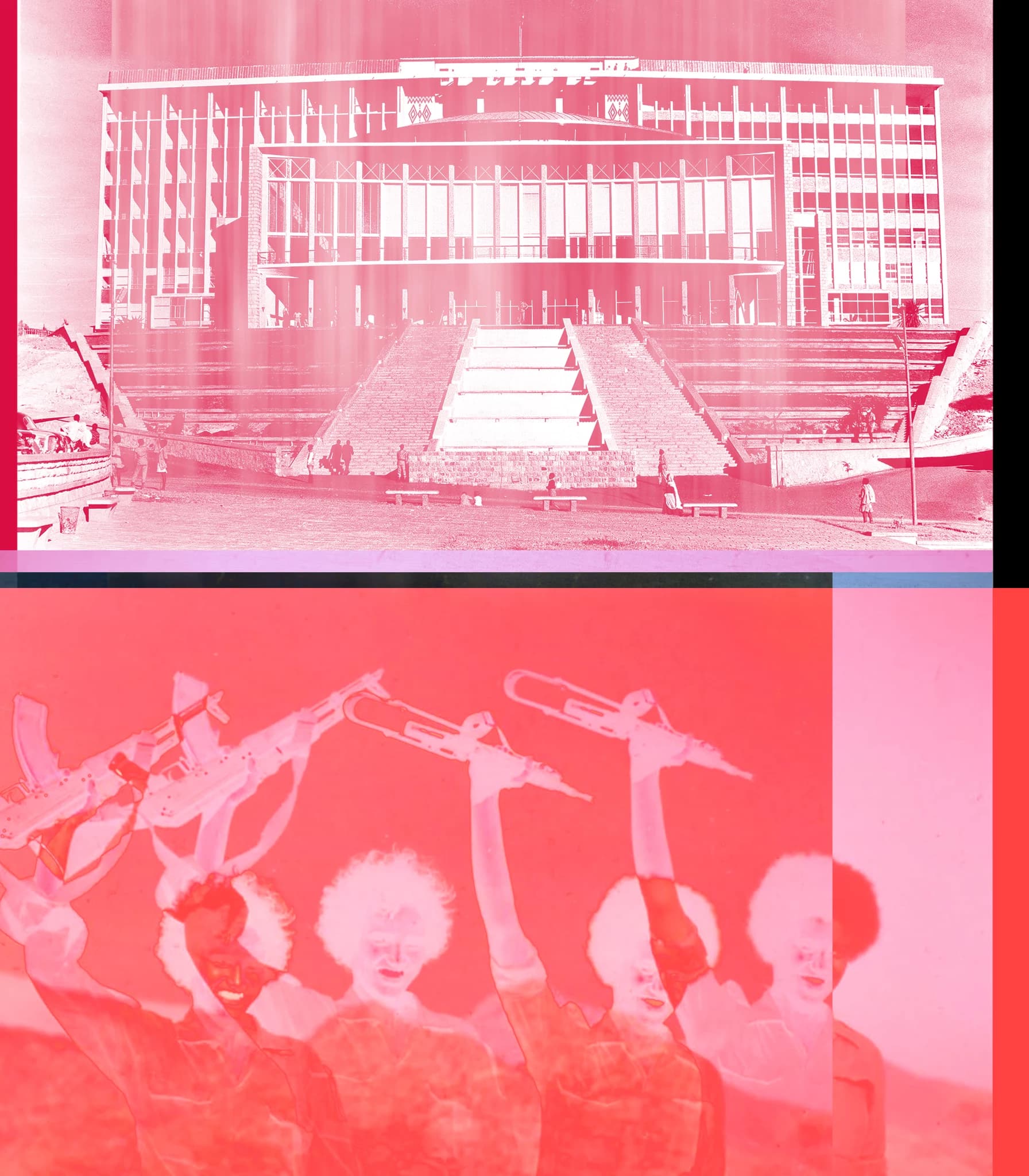
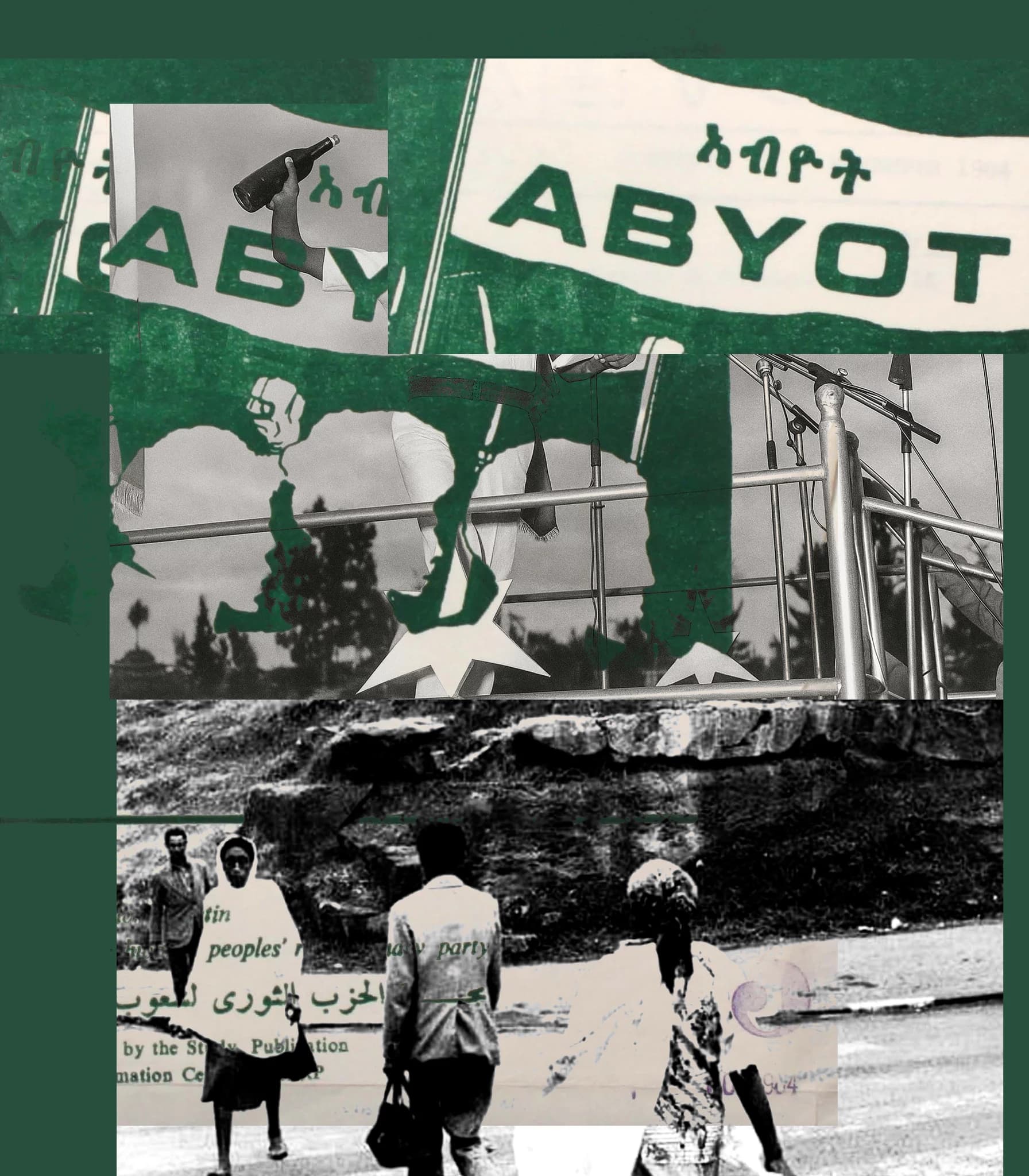
Employing digital photomontage allowed us to work with individual elements rather than pretending that a whole record existed. To the untrained eye a composite image can easily be mistaken for a historical record; therefore, we did not conceal the fact that our compositions were crafted and believe this method of production was symbolic of that augmented record.
Each work mixed photographic elements with rebuilt and imagined components, but made no claim to be authentic representations. In that sense, they served as an epistemic method. They allowed us to distinguish between proof, fabrication, and fantasy, by keeping all three in one image, and they emphasized rather than addressed the missing records.
Pink and red photomontage of architecture and raised arms.
The final exhibition was a considerable representation of our collaboration and effort to map the digital montage work to our geographic representations. We featured sculptural installation of charcoal, image transfer, and silkscreen printmaking. The digital photomontage supplemented these traditional mediums and provided much of the project's conceptual framework. Where conventional medium was limited, digital media extended the message of our work by merging historic archives and our own present photographs, and composing a unique image that physical materials alone could not have produced.
We recognized the charcoal and the black plastic bags as critical materials and associate them with a protective practice: the charcoal is used to ward off evil spirits, while the black plastic is used to conceal a household's valuables from jealous spirits.
This form of play with the materials was to extend that protection "from the spiritual to the political world," as viewers recognise the black plastic as a covering over demolished dwellings. The task was distributed among the two registries. The montage allowed us to read a location's history against the present day site. and the plastic and charcoal made that reading feel like a protective gesture and believed this symbol and its meaning are culturally specific.
Green photomontage of signs, a speaker, and a street scene.
The Nairobi exhibition at The Africa Arts Trust broadened the reach of our work beyond the institutions that had stifled it, but this exhibition also separated our work from the communities whose neighborhoods shaped and defined it.
Three conclusions follow. First is that the restriction of artists' voices does not have to be in the form of prohibition; institutions can merely withhold responses without actively censoring or categorising a work unfit for public view, which inevitably creates a scarcity that intensifies artists’ withdrawal.
Second, political circumstances may impact access to resources and records: digital photomontage was a crucial medium because it allowed us to work with fragmented memories and partial information, while keeping the documented and elements of craft clearly distinct. Lastly, digital networks changed the geography of distribution without providing equitable spaces in the digital commons; the platforms have instead redistributed our attention and dependency which in turn raises questions about the integrity of the infrastructure, its legitimacy and how to build equitable and accessible alternatives.
In all the African nations that politically decolonised in the independence wave of theIn the 1950-90s, the work of decolonisation is incomplete. Traces of colonialism remain inAfrican economies, culture and the psyche of the people. The power dynamics withEuropean countries shifted but did not completely change. Barely begun is psychologicaldecolonisation to dismantle colonial systems of thought and replace them withself-respecting mindsets.
This unfinished business of decolonisation is an especially salient issue for Rwandabecause even the country’s formal independence was tainted. It was not the outcome ofhomegrown resistance but of a counterrevolutionary strategy of the Belgian colonialgovernment.
Rwandan Tutsi, a cow-owning class, were a wealthier class than agrarian Hutu andforaging Twa in pre-colonial Rwanda. The Belgian government issued mandatoryidentification cards separating the three into pseudo-ethnic groups and indirectly ruledthrough the Tutsi monarchy. During the liberation fervor of the 1950s, it was leadersof this wealthier class who rose up to resist Belgian rule and seek independence. Thecolonial government reacted with belated investment in the Hutu population, as acounterforce to the Tutsi independence agitators. This reactionary maneuver by Belgiumengineered a 1959 “Hutu revolution" in which more than 100,000 Tutsis were exiled orkilled. The Tutsi monarch was exiled in the early 1960s. When retreat from the coloniesbecame inevitable, Belgium granted Rwanda independence as a Hutu-dominated republic.
In the newly independent nation of Rwanda, an extremist government embarked on adecades-long campaign of Tutsi exclusion from public and military service, and sporadictargeted violence against the group. Eventually a full extermination was organised andput into action in the 1994 Genocide against the Tutsi.
Given this history, contemporary Rwandan artists, including digital artists, often reachfurther back into pre-colonial Rwanda for symbols, stories and concepts of self that are moreinspirational and less divisive than those that the colonial encounter left Rwanda with.
A new yet familiar visual language
Dolph Banza is one of the artists drawing their inspiration from pre-colonial Rwanda. Hisvisual style in illustration and animation is one of the most recognised in Rwanda’s currentart scene.
People have described his work as ‘new yet familiar,” Banza says. His style, which evolvedorganically over the years as he explored the history and cosmology of precolonial Rwandaand Africa, combines precise technical drawing with traditional Rwandan geometry into anaesthetic that harmonises the old with the modern.
One formative encounter in Banza’s artistic evolution was contact with woven baskets frompre-colonial Rwanda at the MARKK Museum in Hamburg. He was participating in“DecolonyCities Kigali-Hamburg”, a project led by German-Mexican artist Yolanda Gutiérrez.Assigned to sit with the objects and draw them, Banza found himself amazed by how muchprecolonial Rwandans had achieved in terms of design and craftsmanship. “To sit with anobject like that and study what goes into making it, you realise that it follows all the rules weuse in design today such as symmetry, geometry, proportions, balance, harmony,” reflectsBanza
But while he remembered learning about other cultures as a child this knowledge aboutindigenous artistry was not included in his school curriculums. To Banza, the intricateweaving technique suggested that “whoever made [the baskets] was a complex person whoprobably made other complex things.” And that their societies were advanced civilisations.“Things like artistic expression cannot be pursued if your basic needs like food security andshelter are not met. So this art that our ancestors created is proof that there was acivilization and we were not as miserable as colonialists painted us,” Banza argues.
But the creators of his school curriculum clearly hadn’t thought so. “Perhaps if it was madeof metal we would respect it more. But I think it’s even more complicated to make it withdry grass.” Pondering that exclusion was Banza’s wake up call. He realised how incompletethe process of decolonisation was. “Civilizations can be different but it doesn’t mean thatthey are inferior because they didn’t choose a certain path,” he says.
“Civilizations can be different but it doesn’t mean that they are inferior because they didn’t choose a certain path”
Even before his time at the MARKK museum, Banza had been working on a deeperconnection to Rwandan heritage as he searched for a style in which to express himself. Tohim, the only way to be original is to embrace who you are, especially in today’s art climatewhere the internet is packed with trends and AI generated art. He chose Rwanda as hiscanvas because it is where he is and where his responsibilities lay. Still, he appreciates theMARKK experience for giving him a physical reference and the European cultural institutionsthat make such efforts. “I appreciate that as former colonisers, they seem to carry theresponsibility to address topics such as decolonisation.”
In his exploration of heritage, Banza has found many of the readily available archivalresources unsatisfying. “Modern memory material like the now familiar black and whitearchival images of past African life, were not necessarily made to show our greatness; thatwould not have allowed colonialists to justify their occupation,” he says. It got him thinkingof alternative windows into African pasts. “For example, you could study music from thattime, understand its complexity and from there you can project yourself into what kind ofperson made that kind of music,” he says.
Over the years, Banza came to understand – or at least theorise on – the material choices ofhis artistic ancestors. “Our way of doing things was connected to the land and our beliefs.For example, the usage of metal was restricted to only certain things because Rwandansbelieved that too much extraction of metal was interfering with the womb of the earth,”he says.
On the work of decolonisation in Rwanda, Banza observes that “the visual arts and fashionseem to be the ones embracing this more”, and wishes that fields like architecture wouldalso become players in heritage-rooted innovation. “Rwanda could have a unique urbanidentity,” he muses.
He is optimistic that more will happen, citing the recent restitution of Rwandan musicalarchives from Germany as evidence that despite many other priorities, Rwanda is juggling itall with decolonisation efforts. He reckons that "Africans are now more proud of theiridentity and cultures,’ compared to 15 years ago and predicts that decolonisation efforts willmultiply.
Searching for an authentic and forward looking balance
Banza cautions that “decolonisation doesn’t necessarily mean a return to zero. “The world iskind of a village now, our part is to bring our identity into the fabric of the global village.” It’sa sentiment echoed by Gael Hirwa, an independent researcher and storyteller who focuseson Kinyarwanda language and mythology.
Hirwa first encountered decolonisation – as a formal concept in the arts – during Gutiérrez’s‘DecolonyCities’ project. But like Banza, he had been doing decolonial work well before that.“Decolonisation happens because colonisation happened,” he says.
Hirwa curates ‘Inyamibwa’, an online platform that uses archival material to shine a light onthe history of Rwanda, and its language Kinyarwanda. He also writes comics of Rwandanmyths and co-creates multidisciplinary projects with other cultural workers.
His deep immersion with the Kinyarwanda language quickly becomes evident inconversation. He uses old Rwandan analogies and metaphors to express himself, offeringlengthy explanations about the roots of some of the words. Describing a multidisciplinaryproject he created in 2023 with poet Natasha Muziramakenga and Mika, an illustrator, Hirwadetours into an elaboration.
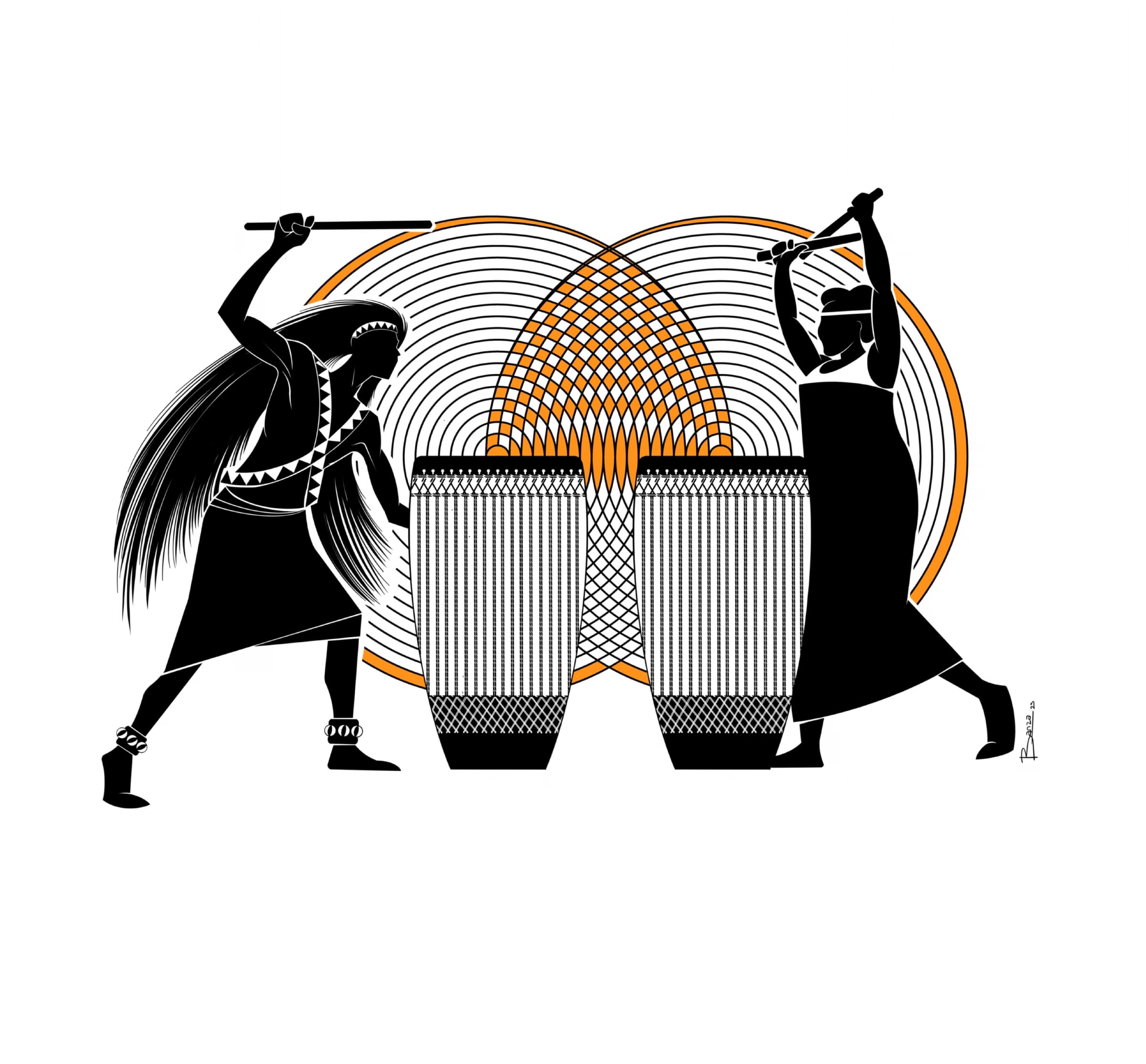
“Intore’ (male dancer) comes from ‘intwari’ (hero). Ingabo (army) is where ‘umugabo’(man/husband) is derived. Umugabo is one who protects his household and that’s why intorewears umugara (sisal mane) and holds icumu (spear). That is an example of the symbolism inthe Kinyarwanda language.”
For the joint project, the artistic trio combined historical research with written and spokenstories to create an audio installation which was accompanied by afro-futuristic drawings byMika. They are still searching for funds to complete a game that was part of their initialconception of the work.
Umugara w’Ikimanuka, a poem that Muziramakenga wrote for the project, was inspired by aBible verse (John 1:1-3; about God’s word and light). The poet recasts the verse’s mythologyonto pre-colonial Rwanda’s. A super long umugara – a sisal-made head costume popularlyworn by Intore dancers to imitate a lion’s mane – falls from the sky and hits the earth. Theimagery echoes to ‘Ibimanuka’ (descendants from heaven), the Rwandan creation myth. “Itwas from ikimanuka’s mane that all Rwandan people came,” Hirwa explains.
Hirwa’s embrace of the poem as part of the joint work is interesting because his critique ofcolonialism is sometimes scathing. When he speaks of European colonisation of Rwanda, hedescribes colonisers as people “who came nk’iya gatera (abruptly) to impose themselves onthe population already there.” He accuses the colonists – Germans and later Belgians, ofdestroying “the paradigm of [the colonised] people; their way of thinking and living.” Hepoints out that even in the school system of post-colonial Rwanda colonialism waswhitewashed. “I remember in school, we used to learn about colonisation through its‘advantages & disadvantages’ and ‘objectives’. Among the objectives was ‘civilisation’ andthen ‘assimilation’,” says Hirwa. “For assimilation to be effective, the culture has to change.They brought their culture and stripped us of ours,” he says.
But on art that marries local heritage with vestiges of colonialism like the Bible verse thatinspired Muziramakenga’s poem, Hirwa is less polemic. “It doesn’t mean you’re notauthentic if you don’t reject everything about colonisation,” he says. He even offersexamples of colonial era changes in Rwandan culture that he considers improvements.“In old Rwanda when a child was born from unmarried parents, the child was believed tobe a curse to the community so the child was sent far away to another place (mostlyislands). The name ‘ikinyendaro’ (bastard) came from the fact that the father did nothave an ‘indaro’ (home) yet. We don’t need that mindset now, a child must be cared forin the community despite the circumstances of their birth.”
Ultimately, Hirwa settles somewhere in between.. “We live in a globalised world now but itdoesn’t mean we must all be uniform. True decolonisation is existing within that worldauthentically with your full identity. Not fully returning to the old or being completelycolonised, but finding an authentic forward looking balance,” he says.
“True decolonisation is existing within that world authentically with your full identity.”
A provisional return to the past
If the complexities of life in the global village are what force Hirwa to in-between land, thefacts of her own birth made Melissa Kurkut a native there. It’s fitting that her intervention isby design an in-between place: a virtual museum stand-in for Africans waiting for therestitution of artefacts taken by colonisers.
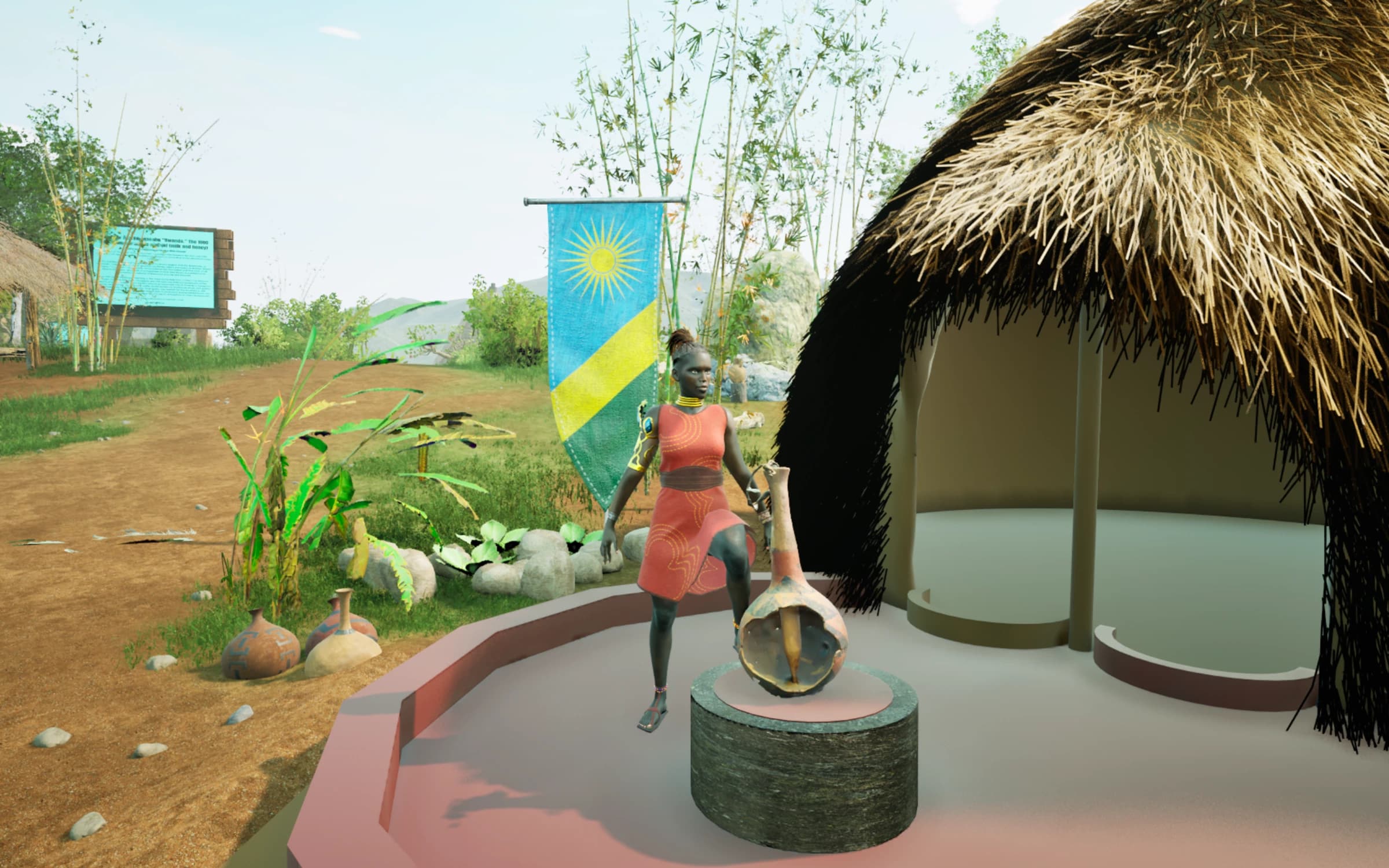
Kurkut is a multidisciplinary artist, curator and researcher of Kurdish and Rwandan heritage.She co-founded Milele Museum in Rwanda, a hybrid cultural hub curating an Africanvirtual museum. Milele partners with museums, libraries, universities, archivists, andcollectives on digitisation, exhibitions, and storytelling projects that reconnect Africancommunities with their heritage.
Kurkut says that her high school education in the Netherlands framed colonisation asproud Dutch history but she heard a different story from her parents at home. Thiseventually led her to seek knowledge beyond the school curriculum. In college, she chose an18-month exchange program in Rwanda where she explored the art scene and engaged inher own art making through photography. That's how she met Milele co-founder Canda, aRwandan visual artist.
The Milele founders reckon that even though efforts to return stolen African artefacts aremultiplying, actual physical restitution will take a while. “Even after they return, the processis not complete because concerns may arise domestically about who gets to keep them (likethe recent disputes in Nigeria about returned Benin bronzes) or how they are kept,” Kurkutsays. She also points out that artists hold little to no power on how the restitution processesgo, given that they are pursued and agreed upon at high levels of power and government.Milele is a digital medium that gives Africans an alternative way to interact with this heritageeven before it manifests physically in our communities. Its projects range from virtualexhibitions and tours to public art installations, popular education and provenance research.The virtual tours and exhibitions reside on the museum's website while its social mediapages publish short form content that shades light on pieces of history from different Africancountries.
Offline, the museum’s team organises in-person workshops and community projects indifferent countries to reconnect young people with their heritage and archive availabletraditional knowledge and artefacts. They hope that this also helps expand the audiencecoming to the virtual museum.
Kurkut hopes that Milele and other artistic efforts in decolonisation rub off on governments,encouraging them to initiate more artefact restitution efforts.
Image from the Rwanda contribution
Baby steps in a constrained reality
The personal explorations by Banza, Hirwa and Kurkut demonstrate that whiledecolonisation is a relatively new word on the Rwandan artistic scene, many artists havebeen doing decolonial work anyway. The three artists are standout examples for their use ofthe digital medium but they represent wider efforts by Rwanda’s youth to reconnect withlost heritage and heal the psychological damage of colonisation and colonial education.
That said, many young people still struggle to reconcile their Rwandan identity with thestrong foreign influences of the global media they consume, the technology-mediatedrecreational activities available to them and the colonial education they receive from ayoung age. Compared to these forces, their access and engagement with pre-colonialcultural heritage remains quite limited.
While that disconnect has driven some individuals to independently seek out alternativeknowledge that gives them the courage to question and re-examine ongoing colonialinfluence on their lives, it’s not a pursuit that all can take on. Rwanda is not perfect. It maybe among the least corrupt, safest, cleanest and fastest growing countries in Africa and itspresident may be an outspoken and practical Pan-Africanist but Rwanda is still a low-incomecountry where the average Rwandan is mostly pre-occupied with putting food on the table,shelter over their family and achieving economic security. Additionally, Rwanda is anenvironment where political discourse is minimal. All this leaves little time to reexamine thestatus quo, question what kind of relationships the government has with European powersor question if our way of seeing things is a Rwandan or colonial.
As such, it isn’t uncommon to see Rwandans ally themselves with influences that promise toimprove their lives in tangible ways, even if they might be vestiges of colonialism. One mighttake a job from a questionable NGO, sell a questionable product (like bleach), only teachtheir child a foreign language because it opens up more economic opportunities or adoptwestern mannerisms for social relevance.
Pursuits like decolonisation are therefore often the preserve of the more educated, inacademia and the arts. And these spaces, and these people are few and far between. Butwith digital mediums serving as an affordable, accessible and fast tool, young people areslowly building an ecosystem for decolonial education for themselves and their peers. Ifthese efforts eventually lead to better resourced initiatives by decision makers in thepolitical, economic and academic realms, young people will have scaled the imagination fora decolonised future in Rwanda.
References
BETTS, R. (2012). Beyond Empire and Nation, The Decolonization of African and Asiansocieties, 1930s-1970s. Brill.
Adebisi, F. (2025). Against “Decolonise X”: Recovering the Radical Meanings ofDecolonisation. Foluke Africa.
Bolin, A., Nkusi, D. (2022). Rwandan solutions to Rwandan problems: Heritagedecolonization and community engagement in Nyanza District, Rwanda. Journal of socialarchaeology, 22(1): 3-25.
Schimmel, N. (2022). Belgian Colonization of Rwanda: Racism, Division and Exploitation.Sage Journals.
Odile Uwera is a Rwandan graphic artist with a passion for storytelling. Her career started 10 years ago as a student of Communication Design at the University of Rwanda. She works as a freelance illustrator and an independent consultant for cultural institutions, translating impactful messages into visual solutions. Unlimited by medium, her independent work travels across writing, comics, film and animation with the story as a foundational drive. She is a published author and a 2023 Rwanda Film Office screenwriting grant recipient.